
US President Donald Trump and top Iranian officials traded sharp warnings today as economic protests spread across parts of Iran, escalating tensions following the US’s unprovoked bombings of the country in June.
Trump wrote on his Truth Social platform that if Iran “violently kills peaceful protesters,” the US “will come to their rescue.”
At least seven people have died so far in the unrest, which has been partly fueled by the collapse of Iran’s rial currency.
“We are locked and loaded and ready to go,” Trump added, offering no further details.
Shortly after, Ali Larijani, former parliament speaker and secretary of Iran’s Supreme National Security Council, claimed on X that the US and Israel were fueling the protests. He provided no evidence for the assertion, which Iranian officials have often made during previous demonstrations.
“Trump should know that US intervention in Iran’s domestic affairs would lead to chaos across the region and the destruction of American interests,” Larijani wrote. “The American people should understand that Trump started this adventurism and take care of their own soldiers.”
His comments likely referred to the US’s extensive military presence in the region. In June, Iran attacked Al Udeid Air Base in Qatar in retaliation for US strikes on three nuclear sites during Israel’s 12-day conflict with the Islamic Republic.
Ali Shamkhani, adviser to Supreme Leader Ayatollah Ali Khamenei and former council secretary, warned that “any hand that threatens Iran’s security will be cut.” He added, “The Iranian people know well the experience of being ‘rescued’ by Americans—from Iraq and Afghanistan to Gaza.”
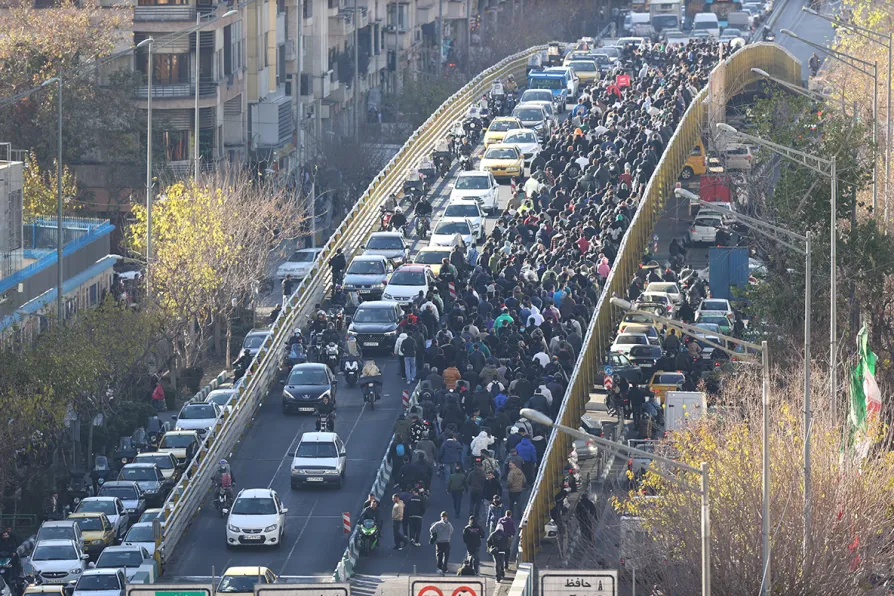
The protests, now entering their sixth day, are the largest in Iran since 2022, when Mahsa Amini’s death in police custody sparked nationwide demonstrations. However, the unrest has yet to spread across the entire country and remains less intense than the 2022 protests over Amini, who was detained for improperly wearing a hijab.
Iran’s civilian government under President Masoud Pezeshkian has tried to show willingness to negotiate with protesters. Still, Pezeshkian admitted that options are limited as the rial continues to plummet.
Although the protests are rooted in economic grievances, demonstrators have also voiced opposition to Iran’s theocratic system.