
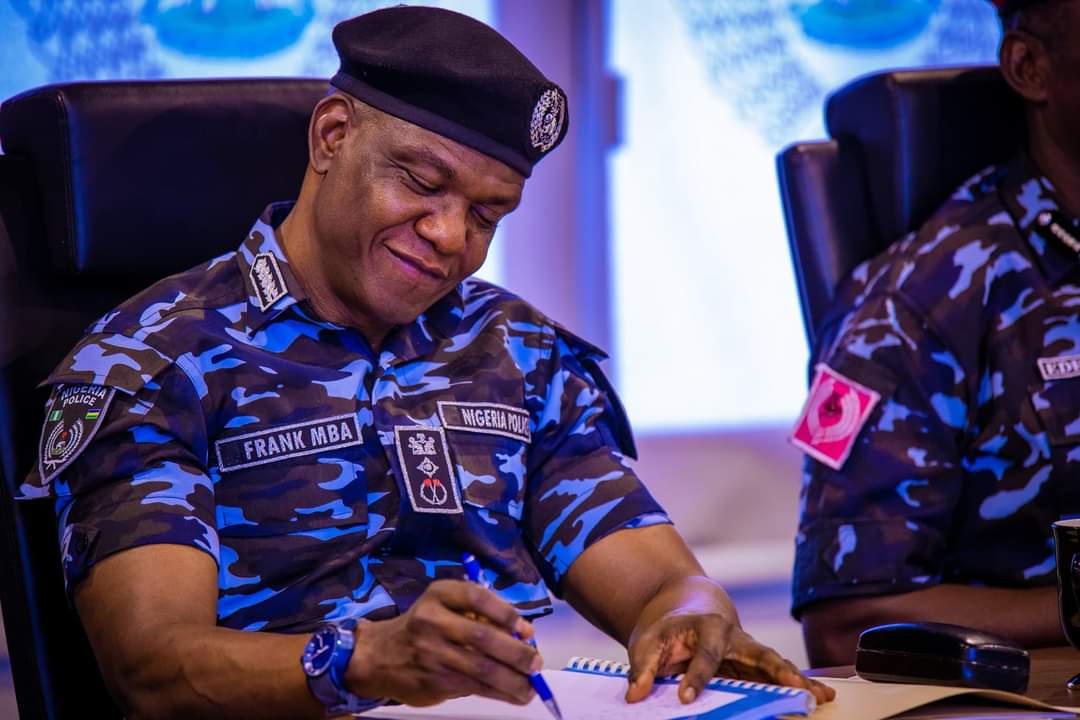
Business Hallmark had reported that the affected officers include several Deputy Inspectors General (DIGs) and Assistant Inspectors General of Police (AIGs), among them Frank Mba (Training and Development), Adebola Hamzat (Logistics and Supply), Yahaya S. Abubakar (Finance and Administration), Adebowale Williams (Information and Communication Technology), Sadiq Idris Abubakar (Force Criminal Investigations Department), and Ben Nebolisa Okolo (Force Intelligence Department).
Their expected retirement was said to be in line with the long-standing police tradition of compulsorily retiring senior officers when a junior officer is elevated to the position of IGP, in order to avoid what is often described as “status reversal” within the command structure.
However, sources said President Tinubu intervened to suspend the planned shake-up, citing the need for stability, continuity, and the institutional experience of the affected officers, especially at a critical time for the Force.
An internal list circulating within the police hierarchy had reportedly identified at least eight DIGs for immediate retirement to preserve the command chain following Disu’s appointment. But a Presidency source disclosed that the move was put on hold to enable the Acting IGP to rely on the expertise of senior officers as he assumes leadership.
Disu’s appointment has itself generated debate, as it comes barely two months before his scheduled retirement. Born on April 13, 1966, in Lagos State, Disu – police serial number AP 41729 – was promoted to the rank of Assistant Inspector-General on March 6, 2025, and is due to retire on April 13, 2026, upon attaining the mandatory retirement age of 60.
Although the amended Police Act provides a fixed four-year tenure for an Inspector-General of Police irrespective of age, there are indications that Disu may not benefit from the full tenure. Unlike his predecessor, Kayode Egbetokun, who enjoyed tenure protection under the amended law, sources suggest that efforts are underway to ensure Disu exits the office upon reaching retirement age in April.
“The push now is to ensure the acting IGP leaves in April as stipulated by law,” a source said, adding that the directive to suspend the mass retirement has rekindled hope among senior officers who had been preparing to leave the Force.
The controversy surrounding compulsory retirements within the Nigeria Police Force has deep legal implications. In June 2023, following Egbetokun’s appointment as IGP, the Police Service Commission (PSC) compulsorily retired DIG Moses Ambakina Jitoboh, despite his being 54 years old and having several years left before attaining either the mandatory retirement age of 60 or 35 years of service.
The PSC had defended its action by citing established police tradition, arguing that senior officers are often retired when a junior officer is promoted above them to avoid disruptions in hierarchy.
Jitoboh challenged the decision at the National Industrial Court in Abuja in Suit No: NICN/ABJ/274/2023, contending that his retirement was unlawful and contrary to statutory provisions governing public service.
In a landmark judgment delivered on January 13, 2025, Justice Osatohanmwen Obaseki-Osaghae declared the compulsory retirement illegal, unconstitutional, and void. The court ruled that the PSC lacked the authority to prematurely terminate the appointment of a senior officer who had neither reached the retirement age nor completed the required years of service.
The court further held that internal policy considerations such as “status reversal” could not override statutory provisions. It ordered that Jitoboh be deemed to have remained in service until June 10, 2029, when he would have completed 35 years, and awarded him N50 million in general damages for the embarrassment and stigma caused by the unlawful retirement, alongside outstanding salaries and N750,000 in costs.
In a tragic development, Jitoboh passed away on December 28, 2024, just weeks before the judgment was delivered.
Legal observers note that neither the PSC nor the Nigeria Police Force appealed the ruling, effectively allowing it to stand as precedent and casting doubt on the legality of similar retirement exercises.
Against this backdrop, Tinubu’s decision to halt the planned retirement of senior officers is seen as a move to prevent fresh legal battles and maintain operational stability within the Force during a sensitive leadership transition.