
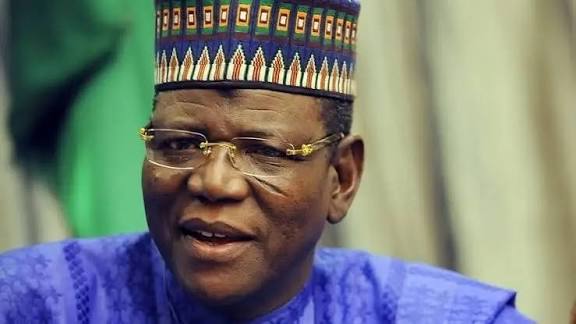
The Supreme Court of Nigeria has ordered a former Governor of Jigawa State, Alhaji Sule Lamido, and his two sons, Aminu and Mustapha, to resume trial at the Federal High Court, Abuja, over alleged N1.35 billion fraud.
This development overturned an earlier decision that halted the case.
In two unanimous judgments delivered on Friday, January 16, 2026, a five-member panel of the apex court allowed appeals filed by the Economic and Financial Crimes Commission (EFCC) and directed the defendants to enter their defence.
The Supreme Court set aside the July 25, 2023 judgments of the Court of Appeal, Abuja, which had upheld a no-case submission by Lamido and others and struck out the 43-count amended charge for lack of jurisdiction.
In the lead judgment delivered by Justice Abubakar Umar, the apex court affirmed the earlier ruling of Justice Ijeoma Ojukwu of the Federal High Court, Abuja, which had dismissed the no-case submission and ordered the defendants to open their defence.
Lamido, who governed Jigawa State between 2007 and 2015, is standing trial alongside his sons, Aminu and Mustapha, as well as Aminu Wada Abubakar, and their companies, Bamaina Holdings Limited and Speeds International Limited on charges bordering on money laundering and abuse of office.
According to the EFCC Spokesman, Dele Oyewale, Lamido allegedly used his position as governor to obtain gratification from companies awarded contracts by the Jigawa State Government and subsequently laundered the proceeds through various bank accounts.
Some of the charges allege that funds paid by Dantata & Sawoe Construction Company Nigeria Limited and Interior Woodwork Limited were converted, retained, or concealed through corporate accounts linked to the defendants.
Another count alleges that a company manager aided the concealment of the alleged proceeds by signing false documents.
The EFCC argued before the Supreme Court that the Court of Appeal erred in law by discharging the defendants despite evidence linking them to the alleged offences.
Meanwhile, on the same day, proceedings continued in the N110.4 billion fraud trial of former Kogi State Governor, Yahaya Adoza Bello, before Justice Maryanne Anineh of the Federal Capital Territory High Court, Maitama, Abuja.
A prosecution witness, David Ajoma, a compliance officer with Sterling Bank and the ninth prosecution witness (PW9), testified that the Kogi State Internal Revenue Service (KIRS) allegedly paid over N1.16 billion as “commission” into a Sterling Bank account belonging to one Philip Kumar within eight months in 2019.
Ajoma told the court that between January and August 2019, a total of N1,164,959,568.13 was paid into the account from KIRS, while N953,404,000 was withdrawn in cash during the same period.
He described the pattern of heavy and frequent cash withdrawals as unusual by banking standards, noting that withdrawals often followed shortly after inflows from Kogi State Government-related accounts.
Led in evidence by prosecuting counsel, Kemi Pinheiro, SAN, the witness explained that the withdrawals in 2019 contrasted sharply with earlier periods, when transactions were minimal and largely conducted through online transfers.
He noted that before January 2019, withdrawals rarely exceeded N1 million.
Ajoma also explained the concept of a Suspicious Transaction Report (STR), stating that such reports are filed when transaction patterns are inconsistent with a customer’s profile or exceed regulatory thresholds.
However, he said, he did not have information on whether Sterling Bank filed any STR in respect of the account.
Under cross-examination, the witness admitted that he did not have access to the account opening documents and could not determine the nature of the business, its signatories, or whether the transactions were consistent with the customer’s operations.
He also said he could not distinguish between funds belonging to the Kogi State Government and those of the Kogi State Internal Revenue Service based solely on the account narrations.
With no further questions from counsel, Justice Anineh discharged the witness and adjourned the case to February 10 and 11, as well as March 11 and 12, 2026, for continuation of trial.