
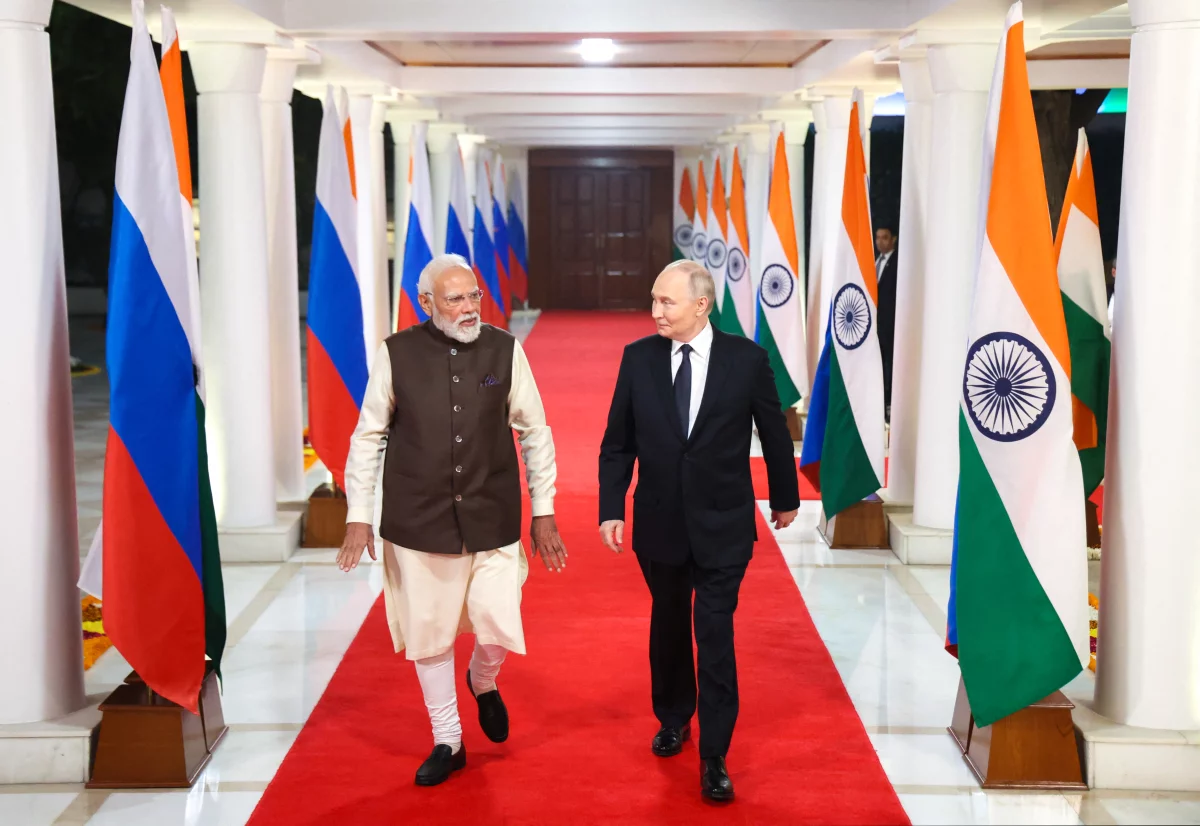
Russian President Vladimir Putin received a ceremonial welcome in New Delhi on Thursday as he began a two-day state visit to India, his first since Russia’s invasion of Ukraine nearly four years ago. Indian Prime Minister Narendra Modi personally received the Russian leader on arrival, marking the visit with public displays of warm diplomacy.
The carefully choreographed welcome featured cultural ceremonies, an honour guard and online tributes shared from the banks of the Ganges. Analysts say the visit sends a clear signal that New Delhi is maintaining strategic alternatives despite mounting Western pressure over its economic relationship with Moscow.
“The visit underlines that India still has geopolitical options,” said Chietigj Bajpaee, a South Asia analyst at Chatham House. “It is an effort to reaffirm a partnership that has come under sustained external pressure.”
India and Russia share decades of close diplomatic ties dating back to the Cold War, shaped largely by regional security concerns and shifting alliances in South Asia. While India has strengthened relations with the United States in recent years, it has resisted calls to scale back strategic cooperation with Moscow.
Putin’s trip also offers rare international exposure, as his global travels have been limited since the International Criminal Court issued an arrest warrant against him in 2023. “A visit to a major democracy like India gives him significant diplomatic visibility,” said international relations analyst Swaran Singh.
Following bilateral talks on Friday, both governments announced new labour agreements that will allow more Indian workers to take up employment in Russia. Putin also pledged continued fuel supplies to support India’s fast-growing economy.
India has emerged as one of the world’s largest buyers of Russian crude oil since the Ukraine war began. However, recent weeks have seen a slowdown in imports after U.S. tariffs on Indian goods were raised and new sanctions were imposed on Russian energy firms.
India’s largest buyer of Russian crude, Reliance Industries, reportedly halted purchases for export refining in November to comply with fresh European Union restrictions on refined products derived from Russian oil.
How Russia will sustain uninterrupted fuel supplies under tightening sanctions remains unclear. Energy analysts note, however, that shipping activity linked to Russian oil has increasingly relied on evasive practices, including the use of falsified vessel registrations.
New Delhi has consistently described Western pressure over its energy imports as unreasonable, pointing out that several Western economies continue to rely on Russian energy in various forms.
At the same time, India has stepped up purchases of U.S. oil and liquefied natural gas in a bid to rebalance trade and manage diplomatic tensions with Washington. “India is walking a diplomatic tightrope,” Bajpaee said. “It is trying to preserve ties with Moscow while expanding its engagement with the West.”
In his public remarks, Modi made a brief reference to the Ukraine conflict, expressing support for peaceful efforts to resolve the crisis and reaffirming India’s readiness to contribute toward a lasting settlement. It was unclear whether his comments directly referenced ongoing U.S.-led diplomatic efforts.
During the visit, both countries reaffirmed their ambition to raise bilateral trade to $100 billion in the near term. Current trade remains heavily tilted toward India’s energy imports from Russia.
Despite the renewed warmth, analysts say India’s long-term strategic trajectory remains closer to the West. The United States remains New Delhi’s most significant defence and economic partner, with the two countries conducting more joint military exercises than with any other nation.
“Russia remains an important strategic partner,” Bajpaee said. “But the overall direction points to a gradual, managed decline in the relationship as India’s cooperation with the U.S. and its allies deepens.”
Still, from New Delhi’s standpoint, recent diplomatic tensions with Washington have reinforced the value of maintaining diversified partnerships. “India increasingly views Russia as a more predictable partner compared to the volatility it sometimes sees from the West,” Bajpaee added.