
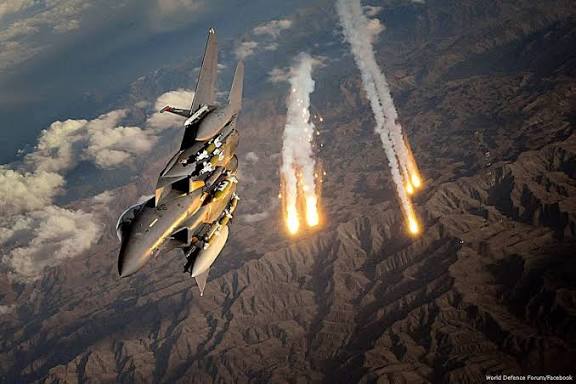
The United States carried out air strikes in Nigeria using information from sources that lacked verification, a New York Times investigation has reported.
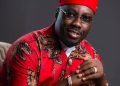
According to the report, U.S. officials relied heavily on claims by Emeka Umeagbalasi, a screwdriver trader and small NGO operator based in Onitsha, Anambra State.
The findings have raised fresh concerns about the quality of intelligence behind the strikes and the wider claim of a Christian genocide in Nigeria.
The newspaper identified Umeagbalasi as the source frequently cited by U.S. lawmakers to support allegations of mass killings of Christians.
It described him as a small-scale tool seller in Onitsha who also runs a little-known advocacy group. Despite this, his research has been used by Republican lawmakers to push what the paper called a misleading narrative.
“The man, Emeka Umeagbalasi, owns a tiny shop selling screwdrivers and wrenches in this market in Onitsha,” the report stated, adding that his work has been cited by Senator Ted Cruz, Representative Riley Moore, and Representative Chris Smith.
Umeagbalasi told the New York Times he documented about 125,000 Christian deaths since 2009. He said he relied on Google searches, Nigerian media reports, secondary sources, and advocacy groups such as Open Doors.
He admitted that he rarely verifies the information or visits affected areas. He often assumes victims’ religion based on where attacks occur.
“If a mass abduction or killing happens in an area where he thinks many Christians live, he assumes the victims are Christians,” the report said.
He also claimed Nigeria has about 100,000 churches, with roughly 20,000 destroyed over 16 years. He said he arrived at the figures by “Googling it.”
Despite these gaps, U.S. lawmakers repeatedly cited his work. The report noted that former President Donald Trump also relied on it to justify air strikes in Nigeria.
The strikes followed growing U.S. actions linked to claims of a Christian genocide.
In October, President Trump redesignated Nigeria as a “country of particular concern,” citing alleged mass killings of Christians. He said Christianity faced an existential threat in the country.
In November, Trump warned that the U.S. military would intervene forcefully if Nigeria failed to stop the alleged killings.
On December 26, U.S. forces carried out air strikes on ISIS targets in north-western Sokoto State. Reports said the action followed a request from Nigerian authorities.
The use of unverified data raises serious questions about the legitimacy of U.S. military action in Nigeria.
Poor intelligence can lead to misdirected strikes and civilian casualties. It also risks shaping foreign policy around inaccurate or politicised narratives.
The case highlights the dangers of relying on advocacy claims without strong verification, especially when they influence military decisions.
Insurgent groups such as Boko Haram have operated in Nigeria for more than a decade. They have targeted both Christian and Muslim communities.
Insecurity in northern Nigeria has caused widespread displacement and loss of life, driven by terrorism and communal violence.
U.S. military operations in Nigeria remain rare and usually involve coordination with Nigerian authorities. Accurate intelligence remains critical to their credibility and impact.