
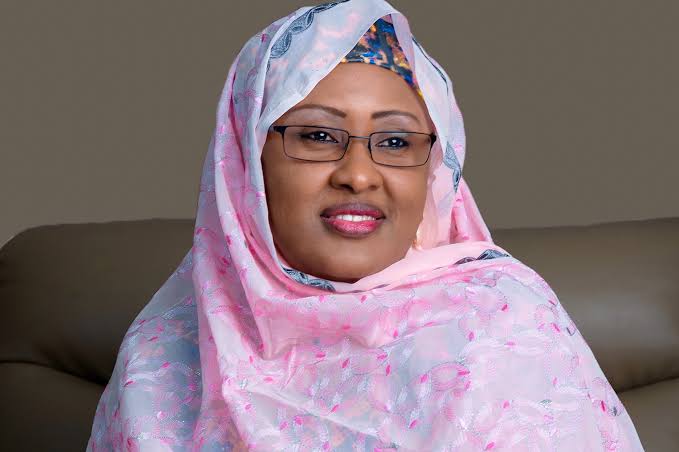
Former First Lady Aisha Buhari has given her most detailed account yet of events inside the Presidential Villa, alleging that powerful unelected figures seized control of access to President Muhammadu Buhari and undermined trust within his household.
Aisha claimed that private areas of the Villa were secretly bugged, with conversations allegedly recorded and relayed to a small circle of insiders. According to her, the surveillance was not part of official security operations but a tool used by individuals seeking influence and leverage around the President.
She said the practice deepened suspicion, weakened internal trust and widened the distance between Buhari and people outside a tightly guarded inner circle.
Her revelations are contained in From Soldier to Statesman: The Legacy of Muhammadu Buhari, written by Dr Charles Omole and recently unveiled at the Presidential Villa in Abuja. The account paints a picture of a presidency heavily shaped by informal power brokers rather than institutional authority.
Aisha said the shift became evident shortly after Buhari assumed office in 2015. Allies who had worked closely with her during the campaign, particularly women, were pushed aside, while access to the President became increasingly restricted.
She recalled seeing a ministerial list circulate outside Abuja and realising that influence had narrowed and that her role as First Lady carried little formal weight within the new power structure.
Rejecting suggestions that the term “cabal” was exaggerated, Aisha described a network of elderly relatives and long-time associates who, she said, viewed her assertiveness as a threat to their influence. She said she refused advice to strike a compromise with them, believing professionalism and goodwill would prevail — a belief she now admits was misplaced.
According to her, the changes also affected her marriage. She said Buhari was more open to debate and criticism before becoming president, but grew increasingly isolated in office and reliant on a shrinking group of advisers.
She maintained that Buhari resisted pressure to anoint a successor or commission opinion polls ahead of the 2023 elections, fearing such moves would fuel internal divisions. In her account, this created space for relatives, loyalists and intermediaries to assert control over his schedule and decisions.
Aisha also addressed long-standing public speculation about Buhari’s health, particularly his 154-day medical stay in London in 2017. She dismissed rumours of severe or unusual illnesses, arguing instead that his condition worsened after Villa aides disrupted a dietary and wellness routine she said she had managed for years.
She claimed her recommendations on nutrition and rest were ignored, and that advisers raised doubts about supplements she provided, briefly convincing Buhari to stop taking them. She said the resulting weight loss and weakness were signs of mismanagement rather than mystery.
When Buhari was later treated in London, she said doctors prescribed even stronger supplements, which he initially resisted until she discreetly incorporated them into his meals. She recalled that his strength and mobility improved within days.
Aisha acknowledged that age and past experiences also played a role, citing Buhari’s years in the field during the civil war, earlier smoking habits and sensitivity to cold environments. She said his final illness was diagnosed as pneumonia, though poor communication by the government allowed speculation to flourish.
Reflecting on Buhari’s final months, she described a period marked by travel, family obligations and quiet medical vigilance. After his death in London at the age of 82, she said official procedures quickly took over.
She praised President Bola Ahmed Tinubu for setting up a burial committee and ensuring state honours, and commended Vice President Kashim Shettima and his wife for their support. She also acknowledged the role of Group Captain Abubakar Sadiq Adamu of the Presidential Air Fleet, who flew Buhari home after his tenure and later returned his remains to Daura.
Aisha noted that figures who once controlled access to Buhari lost their influence after his death. She said neither she nor her children sought revenge, but criticised those individuals as lacking the capacity to manage a presidency.
Her account blends personal memory with political critique, reframing years of secrecy as institutional failure rather than calculated conspiracy. While it may not resolve debates over Buhari’s legacy, it raises a pointed question about power in Nigeria: how much authority rests with elected leaders, and how much is exercised by those around them?