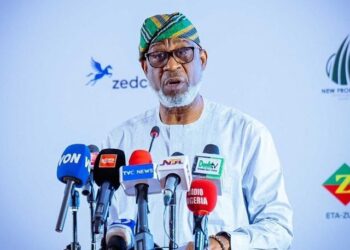

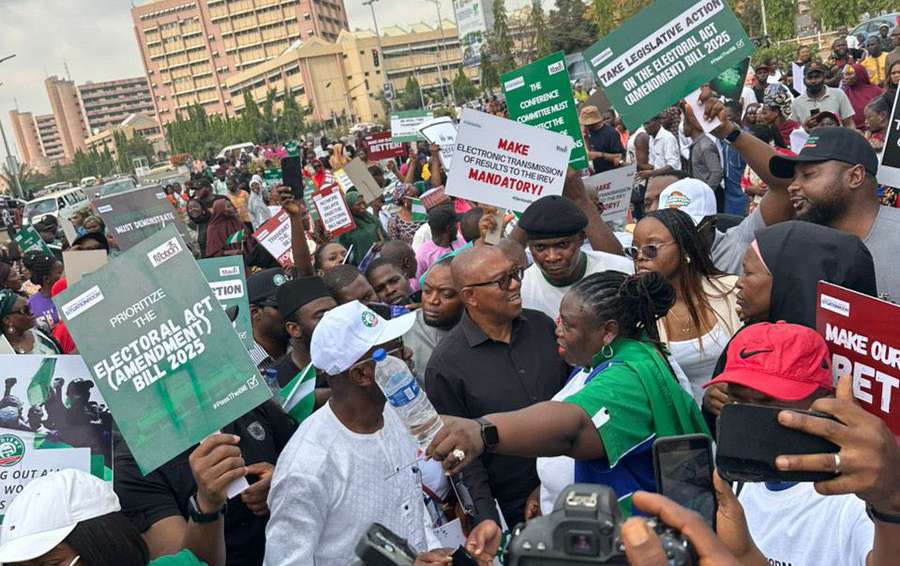
Former Labour Party presidential candidate, Peter Obi, and former Rivers State Governor, Rotimi Amaechi, have joined pro-democracy protesters demanding urgent reforms to Nigeria’s Electoral Act, particularly the retention of mandatory real-time electronic transmission of election results.
The protests, which began at the National Assembly on Monday and continued into Tuesday, were sparked by the Senate’s decision to remove the provision for real-time electronic transmission from the Electoral Act (Amendment) Bill 2026, a move critics say threatens the credibility of future elections.
Taking to his official X handle after participating in the protest on February 9, Obi described Nigeria’s electoral framework as a “disgrace to the continent,” insisting that the country must embrace technology to safeguard the integrity of elections.
He dismissed claims that poor network coverage in some parts of the country makes electronic transmission impracticable, arguing that Nigeria’s banking sector already operates seamlessly through secure digital platforms nationwide.
“Financial institutions operate nationwide through secure digital networks to conduct transactions and collect taxes daily. If banking systems function seamlessly, our electoral system can and should do the same,” Obi stated.
The former Anambra State governor stressed that anyone aspiring to public office must emerge through a transparent and honourable process, including open campaigns, public debates, and full compliance with constitutional requirements.
“Most importantly, election results must be transmitted electronically and in real time to protect the people’s mandate and eliminate manipulation,” he added.
Obi urged Nigerian youths, who turned out in large numbers for the protest, to remain steadfast in the push for credible elections and democratic accountability.
Also lending his voice to the agitation was Amaechi, a former Minister of Transportation and a chieftain of the ruling All Progressives Congress (APC), who joined the protest alongside his son, a medical doctor.
Amaechi explained that he deliberately brought his son along in case the protest turned violent, saying leaders must be willing to stand at the forefront of civic struggles with their families.
“I believe that during major protests, leaders should be at the forefront, accompanied by their families,” he said.
He called on opposition parties, including the Peoples Democratic Party (PDP) and the African Democratic Congress (ADC), to mobilise their members to resist what he described as an attempt to weaken electoral safeguards.
“If we come out and they say the opposition has hijacked the protest, what is the APC doing? Are they not hijacking? What are they afraid of?” Amaechi queried.
He questioned why the ruling party would resist electronic transmission if it was confident in its popularity, noting that several opposition governors and prominent politicians had defected to the APC.
The protest has drawn attention to growing public concern over the future of Nigeria’s electoral integrity, as civil society groups, political actors and youth movements continue to mount pressure on the National Assembly to restore the provision for real-time electronic transmission of results in the amended law.